The rain tonight was incessant, it poured from the heavens upon the canopy of trees above, the leaves offering no shelter from the deluge, while all the while the wind whipped the tree tops above, the branches creaking and cracking in protest. Beneath the branches the young man struggled, his face betraying the misery he felt. His coat had long since yielded to the ingress of water; his clothes were now heavy and sodden. His feet were wet and cold as he slid along the muddy track in his leaking shoes. The once clear path was now more like a stream, while treacherous tree roots seeming to attempt to trip him.
He cursed his own stupidity. He could have taken up the offer of his friend’s couch, could be warm and dry, his hand clutching another warming glass of scotch… the one he had refused as he wished to get back to the family home. “I’m only staying five or so miles away”, he had said, “And I can take a short cut through Witch Woods.”
“Are you sure,” his old friend had said. “It looks a bit wild out there and you know what that wood is like in the dark.”
“Come on,” he had joked. “We were kids back when we scared ourselves with those stories, and I can remember the way through them… its mainly downhill. If I stick to the old charcoal burner’s path I’ll be ok. If not the old crone will have me!” he had laughed.
His old friend had laughed too, if be it in an unconvincing way, again offering his couch, but he had refused, recounting how he had promised his elderly mother to be back at the old family home that night.
So here he now was deep in the Witch Woods, the path seemed to wind more than the map he carried in his childhood memories, and the old ruined charcoal burner’s cottage, by which he could get his bearings had still not appeared. And still the rain fell, the wind seeming to crest the ridge behind him in the tree tops, searching for him, chasing him. Just for a moment he had a tinge of a boyhood fear, he looked up and behind himself into the darkness, his feet still taking him forward. As he peered up the rain splashed on his face, he heard the crack and groan of wood above, his eyes widened as in the shadows he discerned the weight of timber falling towards him. He jumped to the side as the falling tree smashed into the ground where he had just been.
As for him, he had leapt into the unknown and the ground fell away from beneath him. He landed awkwardly on the slippery slope, gravity taking him as he tumbled over and over, unable to stop his mad descent, the brambles tearing his skin and the tree roots digging into his back. He came to a stop in a hollow, the wind was still howling as if it was following up above, he heard more snapping, more splintering of the trees above as the wind screeched, within it he heard a woman’s voice screaming curses.
The man gave a yelp then, as old nightmares resurfaced, he stood up ignoring the painful bruises, his side covered in slimy mud from his slippery fall. He gave no thought to get back to the old charcoal burner’s track, he could only think of the noise of crashing trees behind him now given form by his fear, he scrambled up the other side of the hollow as branches and brambles whipped his face and then he was running, dodging tree trunks in the gloom, roots tried to trip him; all the while the wind was screaming in triumph, as trees fell behind him, an invisible hand reaching to grab him.
He was aware of the distinctive smell of wood smoke and suddenly there was a cottage ahead of him, its overgrown front garden barely distinct from the forest it stood in. He ran up the steps and pounded on the door, the door opened an old woman peered out at him, her eyes seemed to recognise him... and perhaps the dark thing that pursued him.
“In! Quickly!” she said, slamming the door behind him.
He was shaking and sobbing, his eyes shut, as he heard the dark apparition outside rattle the door and then pass over the roof of the cottage as the wind carried on its way.
“You poor thing, you’re soaked to the skin,” the old lady cooed, "Warm yourself by the fire, it’s not a night to be out in, that winds bringing everything down.”
He opened his eyes, the room was dimly lit by a few stubby candles and a blazing fire, he staggered to the hearth as he shivered from terror and the cold, mumbling his apologies for his bedraggled state and the muddy footprints his feet left on the flagstone floor. He slumped into a fireside chair of smooth polished white wood.
He willed the warmth to seep into his bones as the fire crackled and hissed. He looked up into the gloom where the old woman watched him. “I’m so sorry to impose on you, like this.”
“Oh it’s no imposition, my dear.” Her voice had a melodic quality like birdsong. “You just sit and try to get warm now.”
He looked at the fire, as the flames danced like tiny sprites and turned back to the woman, there she was unmoved from before, her eyes deep-set in her gnarled old face, twinkling in the firelight.
“I expect,” he said, indicating the candles, “That the wind has brought down the electricity lines; it’s a good thing you have candles, while the power is out.”
She smiled, “Candles, yes…”
“I used to live hereabouts, a few years ago. I didn’t know this house was here,” he said wearily, the fire twisting and writhing before his heavy lidded eyes.
“Did you not? Perhaps you have just forgotten?” she replied.
“Perhaps I don’t remember, I haven’t been here for ten years, and my memory of the path was somewhat lacking in detail.” he said yawning, his eyes shut momentarily, his mind wandering, walking the woods in the summer with his friend, stumbling across the charcoal burner’s ruined cottage. He opened his eyes, forcing himself awake, as he shivered. “I’m so sorry, I almost drifted off. I never knew someone lived here in the woods. Have you lived here long?”
“The years go by and sometimes people forget”, she replied. “Don’t worry; you sleep if you need to. The fire is burning, as you see, and you are cold and wet.”
He nodded as he shivered again, he looked at the fire burning merrily and yet the warmth didn’t seem to reach him, he closed his eyes, just to rest them, for a little while.
“Yes you’ve just forgotten… ”, she said in her sing song voice.
In his mind’s eye he was there in the old charcoal burner’s cottage, a roofless, tumbledown, single story building, a hovel, long since abandoned. He was there with his friend, sat inside it on a summer’s afternoon telling stories to each other, the sounds of the forest all around.
“The young often do…” the distant voice said, as woodpeckers hammered in the distance.
His friend was telling him the tale, a true one he had said, of the charcoal burner who was greedy and despite warnings had cut down the oldest and biggest tree in the woods, the one with the bark on its trunk shaped like an old woman’s face.
“The old, however, we don’t forget and I’ve always been here…”
In felling the tree from which the woods were named the charcoal burner unleashed a furious, vengeful spirit upon him; his hovel was destroyed and the man was never seen again.
“I remember you…” she chuckled, like crows in the treetops. “You and your friend, here in this very place...”
Icy fingers crawled up his spine and shivering, he opening his eyes, looking at the empty, dark fireplace, the rain dripped down his face making him look up at the trees crowding over the roofless ruin. He stood up, confused and fearful as the wind howled and screeched above. He looked at the chair, the chair made of bleached bones; and he knew whose bones they once were.
He shook his head, turned tail and ran from the ruined cottage, heedless of the rain, heedless of the tree roots, down the old track as the trees groaned and the wind cackled above.
Wednesday, 23 October 2019
Tuesday, 22 October 2019
Spear Havoc
Spear Havoc 1066 - Alternative Histories by C R May
1066AD – a date enshrined in every history of England, all
because of a battle that took place on Senlac ridge on 14th October.
History is written by the victors, we inherit their
narrative. Having always had an interest
in the so-called “Dark Ages”, it always struck me as odd that English history
didn’t seem to really get going until William the Conqueror took to the throne.
All the kings of Anglo-Saxon England
were footnotes, with the exception of Alfred the Great of course. Growing up in
the 1970s we still has access to atlases
with maps still swathed in pink, and history books still full of
imperial pomposity. The conquest was the beginning of British greatness
according to these texts.
But things had changed, even as a child I could see through
those old books. The empire itself had been founded on conquest and oppression abroad and poverty and industrial pollution at home. By the 70s decolonisation was all but complete, on the news there
was industrial strife, the troubles in Northern Ireland rumbled on with no end in sight, shop shelves had sugar shortages and black outs seemed
common place. Mind you, saying that the
music was great… apart from Boney M and the Smurfs of course.
To believe those old history books Anglo-Saxon society had
got as far as it could possibly go and the imposition of Norman overlords was ultimately a good thing. The upper echelons of the pre-conquest society was
primitive. The conquering Normans brought order and modernity, in societal
structure, architecture and warfare.Their victory at Hastings was nearly guaranteed, with their
use of cavalry, foot soldiers and archers. How could the Anglo Saxons hope to
compete with their archaic shieldwall tactics? Those stupid Anglo-Saxon Fyrdmen -
enticed to their doom by William’s reigned retreats! But then you ask yourself;
what if their discipline had held, what would have happened then?
In Spear Havoc 1066 – Alternative Histories, Norse historic
fiction author par excellence C R May explores several intriguing differing
outcomes to our historical reality. Each alternative is presented as a short
story, followed by an afterword exploring the author’s reasoning. Each is perfectly
feasible and, for those of us who hold with the theory of an infinite multiverse,
may very well exist on different timelines.
Thus the author invites us to ponder the differing outcomes
that could quite easily have occurred; what if Harald Hardrada had been killed
prior to his campaign with Tostig Godwinsson?
How untroubled would the succession have been, if Edward the Exile hadn’t
mysteriously died on arrival in England? What if the Confessor had died a year
earlier before the sundering of the Godwinssons?
These are a few among twelve possibilities and, as any
reader of Mr May’s will already attest, each is well described the author’s
prose capturing the excitement of battle and the cut and thrust of political
rivalries. Refreshingly, the author doesn’t just present us with Harold good,
William bad scenarios, instead we have family rivalry and dynastic ambitions
from many quarters; the realpolitik of the time. For the casual reader, or
student of the conquest period, I would heartily recommend getting this book as
it expands understanding of the world of Harold and William, beyond the historical
narrative we all know.
It’s heartening to think that somewhere in the multiverse
there maybe a present as framed in the tale of Tostig the Peace Weaver. What
present is that you ask? I encourage you to get this book and find out!
Wednesday, 12 June 2019
A Light Bulb Moment
To me the new lights seemed harsh. First they installed them
along the street, replacing the warm orange sodium glow of the old ones with a
bluish glare. More energy efficient we were told, with less of the light pollution
overspill that was spoiling the view of the stars. So as it was with energy saving lightbulbs, hand and head torches,
the replacement of traditional incandescent bulbs with LEDs continued apace throughout the
town. All good, yes? I’m not so sure.
It seemed the correct,
environmentally thing to do. Yet still the light is harsh, and almost physically
hurtful to my eyes. The light is always intense under its glare, yet creates
shadowed areas of darkness between them.
Avoiding pedestrians stepping out of the shadows and into the road in
winter, whilst I’m driving, has become somewhat of a seasonal sport.
All artificial light is about mimicking the sun of course,
illuminating the hours of darkness within the narrow band of the
electromagnetic spectrum in which we reside, extending our activity from mere
daylight hours. I did some research; LEDs -light emitting diodes - bathe us in wakefulness
inducing blue light, as the sun does. Other sources emit blue light too, such
as phones and computers etc. which is why we are encouraged into having a down
time from our devices prior to sleep. Blue light has a short wave length and
can damage the photoreceptors in the eye; it is why we wear sun glasses in
summer. Unlike the sun and incandescent bulbs however LEDs do not emit long
wave length red light. Red light has health benefits, stimulating the retina to
repair blue light damage, penetrating the skin and stimulating the production
of mitochondrial ATP; crucial for providing energy in every cell of the body.
It’s not surprising that we have evolved to rely on the sun,
that the ill effects of blue light can be countered by the benefits of the red.
That’s the nature of real light and the universe in general; all seems
perfectly balanced. But LED illumination isn’t natural and I suspect isn’t “real”
light either.
Now it might be my prejudice against LED light but to me its
the natural world that shows it for what it is – a synthetic light. Whilst walking the dog
through an area of the park, the LED shone from the light from amid the branches
of a silver birch. The light on the ground was shown for what it was, the
leaves breaking it up into its digital components of lines. LEDs are here to stay, but do I like them? No I don't. As to whether they actually cause real harm biologically, we are all an experimental work in progress.
Thursday, 10 January 2019
The Raven and the Cross (Erik Haraldsson 2) by C R May - A review
In The Raven
& The Cross, Erik Bloodaxe returns in suitable rampaging style. Previously
we followed him extinguish opposition, in the shape of his brothers, to claim
the kingship of Norway only to have it snatched away by the machinations of
King Aethelstan of England and bequeathed to Erik’s Christian half-brother,
Hakon.
Erik isn’t
going to sit back and accept such a fate, he has loyal Hirdsmen, a wife and sons, and most crucially of all – the destiny to
be a king five times over, as foretold to him by a seer. But how?
He has found
sanctuary in Denmark with his brother-in-law, Gorm and joins him on campaign
against the Swedes. However Eric has an appetite for fame-wealth and he knows,
somehow, he will be a king again, as do others. Athelstan offers Erik the kingdom of
Northumbria in England but Erik suspects this offer is merely to keep him in
check and ensure he doesn’t threaten Hakon’s throne. It would also make him the
king of England’s puppet.
Instead the
Jarldom of the Orkneys offers great opportunity for wealth and plunder. Since
the weakening of dynasties during a terrible war, in which Aethelstan
successfully defeated an alliance of Dublin Norse and Strathclyde Britons, a
power vacuum exists that can be exploited. The Orkneys are perfected situated
on the sea lanes for a Viking Sea King to ply his trade and build his
reputation.
Erik’s
exploits will take him from Dublin to Portugal, but despite King Aethelstan’s
heirs styling themselves as Kings of all the English, and carrying imperial ambition
for the whole of Britain; Northumbrian separatism ensures that the Erik may
still be king there , but on his own terms. Such a move would require accepting
Christianity, but Erik is nothing but a pragmatist, and he needs to be accepted
as king by both Norsemen and Anglo-Danish Northumbrians (both of Berncia and
Deira). The king of Wessex may have other ideas however…
As readers
we have been well served by Mr May of late. The Raven and the Cross is the
second of the Eric Haraldsson series to
be released in 2018 – 2 books in one year – that’s dedication; especially when it’s plain to see the
meticulous research that has gone into these books. C R May has fleshed out
Erik’s life from scant sources, but has been able to explore and expand on
events mentioned in the saga of the Blóðøx
and bring them to life.
![]() |
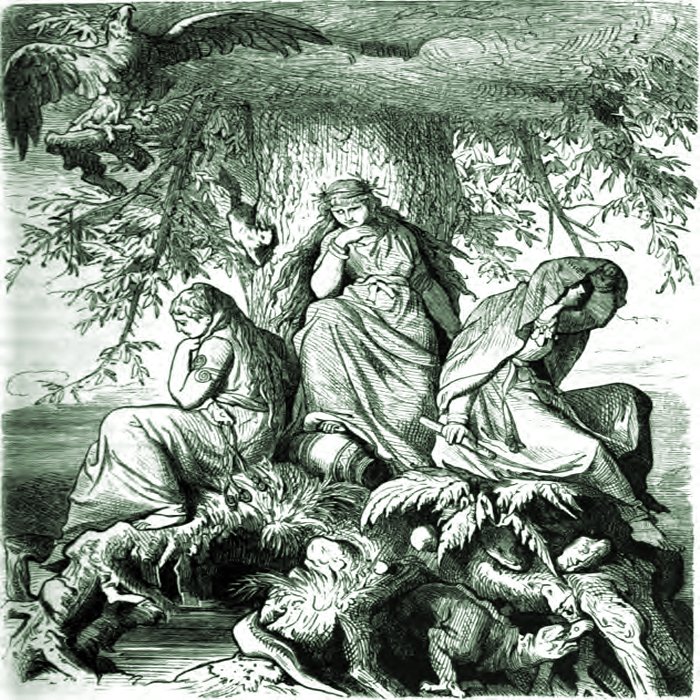
| The Norns Urðr, Verðandi, and Skuld under the world oak Yggdrasil. Illustration, 1882 by Ludwig Burger via wikipedia |
As ever with
this author’s masterly word-craft we are treated to a wonderful recreation of
the Viking world, with all its customs and beliefs and bloody brutal glory. The
tapestry of Erik’s life is skilfully woven, as if it were by the very Norns
themselves. There is action on land and sea with Erik the energetic warrior he
ever was, so much so that the book speeds along; you daren’t put it down. The
previous book dealt with Erik and his headlong rush to win his father’s throne
with the blade of his axe – Jomal;
however the experience of losing his throne through politics has made an
altogether different Erik than the one driven by tempestuous youth.
Erik is a
brave and ruthless warrior, unforgiving of disloyalty; yet the loss of long
trusted hirdsmen, either by death or
age catching up with them, has made a wiser, more philosophical individual. He
can win a kingdom but now he’s learning how to actually be a king and the
requirements of statecraft. A warrior may build a fearsome reputation, but a
great king constructs a legacy.
It’s clear
that the author lives and breathes this world, his love of the period shines
through. For those of us who have enjoyed the work of CR May there’s a nice
little easter egg hidden within the pages of The Raven and The Cross linking
this series to previous ones he’s written. Book two of a trilogy this may be
but it can still stand alone on its own terms. We all need to start somewhere
and if you haven’t read any of CR May’s books before, I would happily recommend
that this be the one to begin with; but you wouldn’t want to deny yourselves
others, would you? So stand with Erik Blóðøx
and hear Jomal’s deadly wail. “Óðinn owns you all!”
![]() |
| Image from cgtrader.com |
The Raven and The Cross is available from Amazon
Thursday, 13 September 2018
The Brand New Normal - For Sam.
So this is the
brand new normal, a hole in my heart and soul.
I’m bereft since
you left; disbelieving, that you suddenly had to go.
Where once I
complained when you shouted, now I just miss your bark.
And that you’re no
longer hogging the sofa, and claiming the comfy part.
You’re not there in
the middle of the doorway, underfoot, refusing to budge.
Nor there when the
fridge door opens, at mealtimes I don't feel your nudge.
You’re no longer
leaning against my legs, with your head and ears to smooth.
No more are you
insisting that you lick mine, sat on me so I can’t move.
Of course you knew
all this made my life sweeter,
with just the touch
of your cold wet nose.
So this is the
brand new normal, I’ll get used to it, I suppose.
Monday, 14 May 2018
Bloodaxe (Erik Haraldsson Book 1) by C R May - A review
“Tell me about King
Erik, Your Grace.”
The archbishop blew
the froth from his ale and peered across the rim, chuckling softly as he took a
sip. “Bloodaxe?”
Under Harald Fairhair Norway has been unified, but the
question of succession casted a shadow over the great king’s twilight rule. He
wants Erik to be his heir for high kingship, but Harald has fathered many sons,
all kings in their own right, each eager for the spoils the great king’s death
will bring.
I’ve always had a fascination with the character of Erik
Bloodaxe, the last Viking king of an independent Northumbria, if only for his
descriptive name. If you’ve ever had the pleasure of visiting Jorvik Viking
museum you may well have bought the T-Shirt or perhaps the mug, such as I have!
When I heard that C R May was embarking on telling his
Erik’s saga I knew I would be in for a spectacular ride aboard a dragon prowed
longship; and what a ride this is. Those familiar with Mr May’s (in my opinion)
unrivalled word-craft in bringing this historical period to life, will have an
inkling of what to expect, and for those new to his work, you will be in for a
real treat and wonder why you haven’t read his work before. You can taste the
salt tang of spray as you pull oar on Erik’s Skei, feel the fear and pride as your sea king disembarks first, to lead
his hird to a bloody and glorious
victory, amid hoarse shouts of blóðøx.
It is the author’s great skill that he is able to put flesh
on the bones of a few lines of Norse literature and create a wealth of
believable characters, which the reader becomes utterly invested in. Mr May invites his reader to suspend their
disbelief in the fantastic with such subtlety that the presence of a
lycanthropic monster, or the earthly manifestation of a god, is accepted
without question. This is the heroic world where tales are told in the mead
hall and monstrous shapes summoned by skalds in the shadows of flickering
flames. Odin, the All-Father, does love his poetry, after all.
"When
one-eyed wandering poets ask you to honour their wishes Erik, it's usually a
good idea to do so... Particularly if they haven't aged a day in twenty
winters."
Yet just when you think the tale is told, that a kingdom is
won and Erik’s tapestry is woven, such is the fate of men that the three
sisters of wyrd pick at loose threads, their shears poised to cut the warp and
weft of heroes, and bring all crashing down in ruination and death in the world of Midgard. For, as Erik has
concentrated on the Nor’way, foreign kings
have conspired to weave patterns of their own.
But Erik has a destiny, told him by a warlock of the far
north, and will snatch the threads of his life from the blades of the hags of
fate, which fortunately for us means there will be an Erik Haraldsson Book 2.
Form the shieldwall, raise the standard, Blóðøx! Blóðøx!
This is historical fiction as it’s
meant to be written, absolutely top notch stuff from a writer at the peak of
his craft.
Bloodaxe is available at Amazon
Monday, 19 February 2018
The Wolf Banner by Paula Lofting - a review
“1058. This year Alfgar,
the earl, was banished; but he soon came in again, with violence, through
Gruffudds' aid. And this year came a fleet from Norway: it is tedious to tell
how all these matters went.”
So wrote a scribe, his
opinion preserved for all these long ages since in the Anglo-Saxon Chronicle.
“Tedious to tell”? Not at all, as we revisit C11th Horstede in Sussex and
reacquaint ourselves with Wulfhere and his household, who we met in Sons
of the Wolf.
Wulfhere is a man tormented by inner demons,
suffering from combat stress, his relationship with his pregnant mistress
putting implacable strain on his marriage to his wife, Ealdgytha. While his
children squabble incessantly, the long running blood feud with his neighbour
Helghi bubbles away, despite his lord Harold Godwinson ordering his two Sussex
liege men to bury their hatchets, by way of marriage. The one bright ray of
sunshine is the impending marriage of his eldest daughter to the Aemund son of
his friend Leofnoth… as long as her dalliance with Helghi’s son hasn’t ruined
her chances of a fortuitous union, that is.
Meanwhile in the strategically important earldom
of Mercia, the elderly Earl Leofric is dying. His son Aelfgar should inherit
the earldom but is tainted by his previous exile and subsequent ransacking of
Hereford in the company of his ally, Gruffudd of Wales. Will Aelfgar’s hatred
of the growing power and influence of the Godwinsons overpower his loyalty to
King Edward? What of Aelfgar’s first born son Burgheard? He condemned his
father over Hereford, where do his loyalties now lie?
Wolf Banner is a
real page turner, through the eyes of the characters we can see the unfolding
drama of the C11th. It is extremely well researched as all the
threads of the time begin to create the tapestry leading up to inevitable
conflict and destruction of this world. The characters are fleshed out and
flawed, not one is a perfect hero, each has their weaknesses or will take
advantage of others in their pursuit their goals.
Having enjoyed Ms Lofting’s first book of this
series it was a joy to return to the C11th. Her storytelling goes
from strength to strength. This is an author whose craft is becoming as sharply
honed as the blades wielded in the battles she admirably describes.
Words of the time are skilfully entwined in the
dialogue making the world all the more real. All life is here; love, desire,
hope, distrust, betrayal, war, triumph and achingly painful loss. There is
humour in Aemund’s battle with his wife’s aunt Gunhild, as a reader I
thoroughly enjoyed the old battleaxe‘s humiliation - well deserved I think! The
war of words between Burgheard and his adversary Ragnald in Wulfgar’s hall was coarsely
realistic but absolutely enjoyable; I felt like I was there listening to the
increasingly ill-tempered debate and trading of insults.
Surely you can tell an author’s worth if you feel
emotionally invested in the characters, and you do in The Wolf
Banner. I felt sorry for Burgheard, and sympathetic to his growing
bitterness but it was good for him to have a storyline to be told, as he is a
mere footnote, briefly mentioned in the writings of the time. Another character
you feel for his Wulfhere’s youngest son, Tovi. Sacrificed in an attempt to
heal the rift between his parents, his dreams trampled and abandoned, I feel he
may yet be the one to save his father from his deep and crippling despair.
1058, tedious to tell? To the scribe perhaps but
not for our characters in The Wolf Banner; their fates are set
on their courses and their tales will continue in The Wolf’s Bane, there is the none-too-small matter of
a blood price that requires payment; I can’t wait.
The Wolf Banner is available at Amazon
Subscribe to:
Posts (Atom)